


Introduction
If you are shopping for jewelry, you have probably seen moissanite described as a diamond alternative. It can look remarkably similar to diamond, but it is not the same gemstone. Moissanite is made from silicon carbide and has its own optical and physical properties, including a distinctive amount of fire and double refraction.
So, what is moissanite, and how does it compare with diamond? Is a moissanite ring a good choice for an engagement ring? What about moissanite earrings, chains, or even a moissanite watch?
This guide breaks down moissanite vs diamond in straightforward terms so you can understand the differences and decide which option makes sense for your budget, style, and priorities.
What Is Moissanite?
Moissanite is a gemstone made from silicon carbide (SiC). Natural moissanite is extremely rare, so the moissanite used in modern jewelry is generally laboratory-created. The gemstone became popular as a diamond alternative because of its brilliance, durability, and strong fire.
Moissanite was first identified in a meteorite crater by French chemist Henri Moissan. The gem material used for jewelry today is produced in laboratories rather than mined in the same way as natural diamonds.
It is important to understand one basic distinction:
Moissanite is not a type of diamond.
A moissanite diamond is a phrase you may see in online searches or jewelry listings, but technically moissanite and diamond are different gemstones. Diamond is made of carbon, while moissanite is silicon carbide.
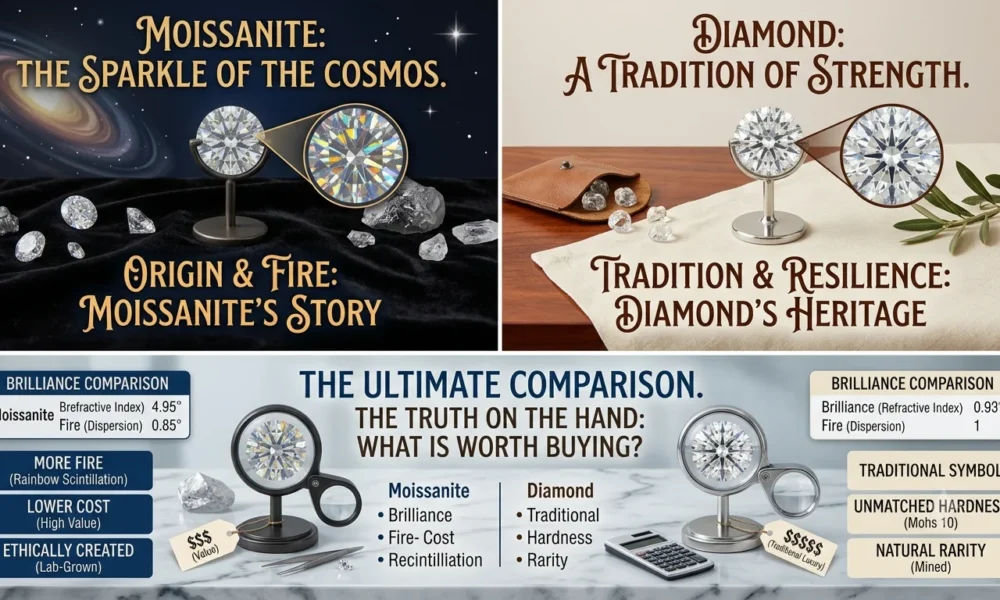
Moissanite vs Diamond: Key Differences
The easiest way to understand the comparison is to look at their fundamental properties.
| Feature | Moissanite | Diamond |
|---|---|---|
| Composition | Silicon carbide | Carbon |
| Typical jewelry origin | Lab-created | Natural or lab-grown |
| Mohs hardness | About 9.25 | 10 |
| Optical character | Doubly refractive | Singly refractive |
| Fire | Very strong | Lower than moissanite |
| Appearance | Bright, colorful flashes | Classic diamond brilliance and sparkle |
| Durability | Very durable for jewelry | Extremely hard and durable |
| Is it a diamond? | No | Yes |
GIA reports that moissanite has a hardness of about 9.25 on the Mohs scale, compared with diamond’s hardness of 10. GIA also notes that moissanite has more pronounced fire and can display double refraction, which helps distinguish it from diamond.
The biggest visual difference: fire
One of the easiest differences to notice is fire, meaning flashes of spectral colors produced when light is dispersed through the gemstone.
Moissanite can produce particularly strong rainbow-like flashes. GIA notes that its fire is substantially higher than diamond’s, which can be especially noticeable in larger stones.
Some people love this intense sparkle. Others prefer the more restrained appearance traditionally associated with diamond.
Neither preference is objectively right—it comes down to the look you want.
Is Moissanite a Real Gemstone?
Yes, moissanite is a real gemstone. It is not a fake diamond; it is a different gemstone with its own chemical composition and characteristics.
The confusion usually comes from the fact that moissanite is commonly used as a diamond simulant. A simulant is a material that resembles another gemstone visually but is not chemically the same.
GIA classifies synthetic moissanite as a diamond simulant rather than a diamond.
That distinction matters when shopping. A reputable seller should clearly identify whether a piece contains moissanite, natural diamond, or laboratory-grown diamond.
Moissanite Ring: Is It Good for Everyday Wear?
A moissanite ring can be a practical choice for everyday jewelry because the stone is hard and durable.
At approximately 9.25 on the Mohs scale, moissanite is harder than many commonly used gemstones, although it is not as hard as diamond. GIA describes synthetic moissanite as having excellent durability for jewelry.
This makes moissanite rings particularly popular among people who want the appearance of a brilliant colorless stone without choosing a diamond.
Things to consider before buying a moissanite ring
Think about:
- Color: Moissanite can range from colorless to near-colorless, depending on the stone.
- Cut: Cut has a major effect on how the stone handles light.
- Shape: Round, oval, cushion, emerald, pear, and other cuts create different looks.
- Setting: The metal and setting style can significantly change the overall appearance.
- Size: Larger moissanite stones can show more of their characteristic colorful fire.
- Personal preference: Some buyers love the extra sparkle; others want a more diamond-like appearance.
Moissanite Earrings: Who Are They For?
Moissanite earrings can be an attractive option for people who want bright, everyday jewelry.
Studs, hoops, drops, and other styles can all incorporate moissanite. Because the gemstone is durable and highly reflective, it can work well for pieces that are worn regularly.
For earrings, you may want to prioritize:
- A well-made setting
- Comfortable metal and backing
- Appropriate stone size
- A cut that suits your style
- A reputable seller
You don’t necessarily need the largest stone. Smaller stones can provide plenty of sparkle without making the jewelry look overly dramatic.
What About a Moissanite Chain?
A moissanite chain typically refers to a chain or necklace decorated with multiple moissanite stones or moissanite-set components.
Unlike a traditional pendant with one central gemstone, these pieces can use numerous small stones to create a continuous sparkling appearance.
If you are considering one, pay attention to:
- The quality of the metal
- How securely the stones are set
- The clasp
- Total chain weight
- Stone arrangement
- Seller reputation
The gemstone itself is only one part of the jewelry’s overall quality.
What Is a Moissanite Watch?
A moissanite watch is a watch decorated with moissanite stones, often around the case, bezel, dial, or bracelet.
It is important to distinguish the watch itself from the gemstone. Moissanite is being used as a decorative material; it does not make the watch mechanism different from other watches.
If you are shopping for one, evaluate the watch movement, construction, water resistance, warranty, and materials separately from the moissanite decoration.
A watch can have impressive-looking stones while still having an average-quality timekeeping mechanism, so don’t judge the entire product by its sparkle.
Is Moissanite Cheaper Than Diamond?
Moissanite is generally positioned as a lower-cost alternative to diamond, but there is no single price difference that applies to every stone or piece of jewelry.
Prices vary according to factors such as:
- Stone size
- Cut
- Color
- Clarity
- Brand
- Metal
- Setting
- Craftsmanship
- Retailer
The most useful comparison is therefore not simply “moissanite costs X% less.” Instead, compare complete pieces of jewelry with similar designs and materials.
For example, if two rings have different metals, settings, stone sizes, and craftsmanship, comparing only their center stones won’t give you a fair picture.
Moissanite vs Diamond for an Engagement Ring
For an engagement ring, the choice often comes down to appearance, symbolism, budget, and personal preference.
Choose moissanite if you want:
- Strong rainbow-like fire
- A durable gemstone
- A lab-created gemstone
- A diamond alternative
- A distinctive sparkle
- Potentially lower overall jewelry costs
Choose diamond if you want:
- The traditional diamond gemstone
- A stone composed of carbon
- Maximum hardness on the Mohs scale
- The classic diamond appearance
- The symbolism associated with diamond engagement rings
There is also a third option worth knowing about: lab-grown diamond.
A lab-grown diamond is still diamond—it has the same basic crystal structure and chemical composition as natural diamond, although its origin is different. Moissanite, by contrast, is a separate gemstone.
Moissanite vs Lab-Grown Diamond
This distinction is often overlooked.
| Moissanite | Lab-Grown Diamond | |
|---|---|---|
| Is it diamond? | No | Yes |
| Main composition | Silicon carbide | Carbon |
| Origin | Laboratory-created for jewelry | Laboratory-grown |
| Hardness | About 9.25 | 10 |
| Fire | More pronounced | Diamond-like |
| Appearance | Diamond-like but distinct | Essentially diamond |
| Best for | Diamond alternative | Those who want an actual diamond |
If your priority is owning a diamond, moissanite isn’t a substitute in the literal sense. If your priority is getting a beautiful, durable gemstone with a diamond-like appearance, moissanite may be worth considering.
Is Moissanite Worth Buying?
Moissanite can be worth buying if you like its appearance and want a durable alternative to diamond.
The best reason to buy it is not simply because it may cost less. You should actually like the stone’s characteristic sparkle.
Moissanite may be a good choice if:
- You prefer strong brilliance and colorful fire.
- You want a durable stone for everyday jewelry.
- You are comfortable buying a gemstone that is not diamond.
- You prefer a lab-created gemstone.
- You want more flexibility in your jewelry budget.
You may prefer diamond if:
- Having a genuine diamond is important to you.
- You prefer traditional diamond optics.
- You don’t want the more pronounced fire associated with moissanite.
- Diamond’s symbolism matters to you.
How to Choose a Good Moissanite
When shopping for a moissanite ring, earrings, or other jewelry, don’t focus only on carat-equivalent size.
1. Look at the cut
Cut strongly influences how light interacts with the stone. A well-cut gemstone can appear much more lively than a poorly cut one.
2. Consider color
If you want a diamond-like appearance, compare the stone carefully in different lighting conditions.
3. Examine the setting
The setting protects the stone and affects the jewelry’s appearance. Prongs, bezels, halos, and other designs each create a different look.
4. Check what you’re actually buying
Make sure the product description clearly states:
- Gemstone type
- Metal type
- Stone dimensions
- Number of stones
- Color information
- Warranty or return policy
This is particularly important when shopping online.
5. Buy from a transparent seller
A trustworthy jewelry seller should clearly identify the gemstone rather than using vague wording such as “moissanite diamond” in a way that could make shoppers believe they are purchasing an actual diamond.
How to Care for Moissanite Jewelry
Moissanite is durable, but that does not mean jewelry is indestructible.
For routine care:
- Clean jewelry regularly using a method appropriate for the metal and setting.
- Avoid exposing jewelry to unnecessary impacts.
- Store pieces separately to reduce scratching between items.
- Check prongs and settings periodically.
- Follow the manufacturer’s cleaning recommendations.
If you are unsure about a particular setting or metal, a professional jeweler can advise you on the safest cleaning method.
Moissanite vs Diamond: Which One Should You Choose?
There is no universal winner.
Choose based on what matters most to you:
| If your priority is… | Consider |
|---|---|
| Traditional diamond | Diamond |
| Strong colorful fire | Moissanite |
| Maximum hardness | Diamond |
| Lab-created alternative | Moissanite |
| Actual diamond composition | Diamond |
| Diamond-like appearance | Either, depending on preference |
| Everyday durability | Both can be suitable |
| Distinctive sparkle | Moissanite |
| Traditional engagement-ring symbolism | Diamond |
The most important thing is to understand the distinction before buying. Moissanite is a genuine gemstone, but it is not a diamond. GIA’s gemological research clearly distinguishes synthetic moissanite from diamond based on its composition and optical properties. (gia)
Frequently Asked Questions
What is moissanite?
Moissanite is a gemstone made from silicon carbide and is commonly laboratory-created for use in jewelry. It resembles diamond but has different chemical and optical properties. GIA describes synthetic moissanite as a durable diamond simulant with strong brilliance and fire.
Is moissanite a diamond?
No, moissanite is not a diamond. Moissanite is silicon carbide, while diamond is carbon, so they are different gemstones even though moissanite can closely resemble diamond visually.
Is moissanite good for an engagement ring?
Yes, moissanite can be a good choice for an engagement ring because it is hard, durable, and highly brilliant. Its distinctive rainbow-like fire makes it look different from diamond, so buyers should choose it because they like that appearance.
Is moissanite better than diamond?
Moissanite is not universally better than diamond because the two gemstones serve different preferences. Moissanite offers strong fire and durability, while diamond offers the traditional gemstone, maximum Mohs hardness, and classic diamond appearance.
Does moissanite sparkle more than diamond?
Moissanite generally produces more pronounced fire than diamond. GIA notes that moissanite has substantially higher dispersion, which can create stronger rainbow-colored flashes, particularly in larger stones.
Are moissanite rings durable enough for everyday wear?
Yes, moissanite is generally durable enough for everyday jewelry when properly set and cared for. Its Mohs hardness is about 9.25, although diamond remains harder at 10.
Final Thoughts
Moissanite is a legitimate gemstone, not a fake diamond. Its silicon-carbide composition, high hardness, strong brilliance, and distinctive fire make it an appealing option for rings, earrings, chains, and other jewelry.
When comparing moissanite vs diamond, don’t ask only which one is “better.” Ask which one matches your priorities. If you love intense sparkle and want a durable lab-created alternative, moissanite may be an excellent fit. If you specifically want a diamond and its traditional qualities and symbolism, choose a diamond instead.
Before purchasing a moissanite ring or another piece of jewelry, compare the complete product—including the gemstone, metal, setting, craftsmanship, seller policies, and warranty—not just the stone itself.

Other Articles

No Comment! Be the first one.