

Introduction
A mood ring can seem almost magical: you put it on, the stone changes color, and suddenly you have a supposed clue about your emotional state. But what is actually happening inside the ring?
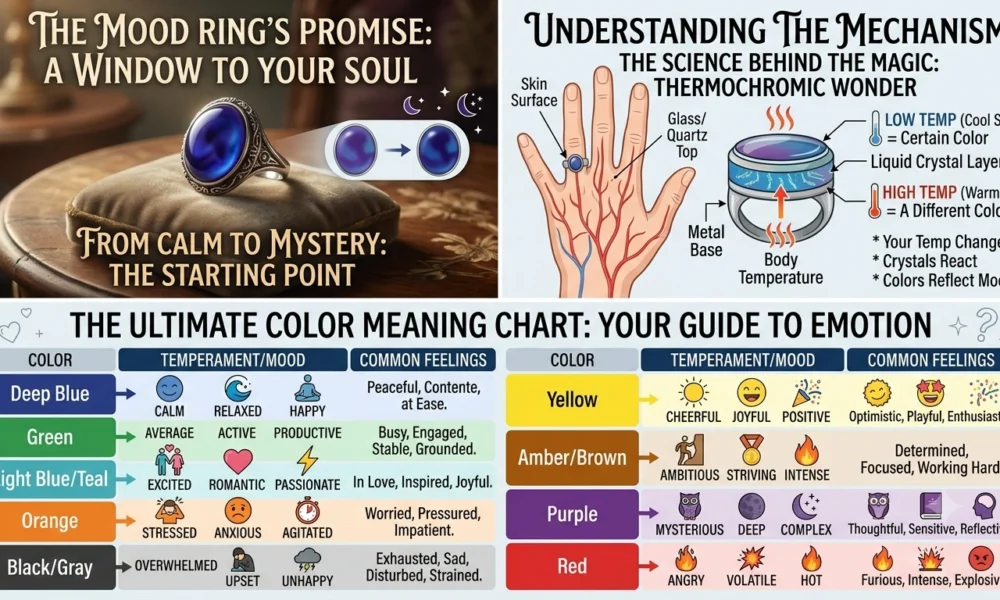
Understanding mood ring color meanings requires separating the traditional interpretations from the science behind the color change. Mood rings generally use thermochromic material, which changes appearance as its temperature changes. Because skin temperature can vary with factors such as the environment and circulation, the color is not a scientifically reliable way to identify a specific emotion.
Still, the traditional color chart is fun to explore. In this guide, you’ll learn what the common colors are said to mean, why purple is associated with certain moods, how temperature affects the ring, and how to interpret your ring without treating it as a medical or psychological test.
What Is a Mood Ring?
A mood ring is a piece of jewelry designed to change color in response to temperature.
The stone or decorative element typically contains or is backed by thermochromic material. “Thermochromic” simply means that the material changes color when its temperature changes.
The idea behind mood rings is that changes in emotional state can sometimes be accompanied by changes in skin temperature. For example, stress can affect blood flow to the extremities in some circumstances. However, the ring cannot directly detect emotions.
That means the traditional color meanings are best viewed as fun interpretations, rather than scientifically established readings of your mood.
Mood Ring Color Meanings Chart
Here’s a simple mood ring color meanings chart based on commonly published traditional interpretations. Exact colors and meanings can vary between rings because different manufacturers may use different thermochromic materials and color scales.
| Mood Ring Color | Traditional Interpretation |
|---|---|
| Black | Stress, tension, nervousness or cold |
| Gray | Anxiety, uncertainty or unsettled feelings |
| Brown | Nervousness or restlessness |
| Yellow | Mixed feelings, distraction or mild anxiety |
| Green | Calm, balanced or relaxed |
| Blue | Peaceful, comfortable or relaxed |
| Dark Blue | Strong calmness or positive feelings |
| Purple | Romantic, passionate or emotionally engaged |
| Pink | Affection, warmth or excitement |
| Red | Energy, excitement or strong emotion |
| Orange | Nervousness, excitement or emotional stimulation |
Important: These meanings are traditional mood-ring interpretations, not scientifically validated measurements of emotional states.
What Do Mood Ring Colors Really Mean?
If you’re looking for real mood ring color meanings, the most important answer is surprisingly simple:
The color primarily tells you about the temperature of the thermochromic material, not a specific emotion.
Your finger temperature can change for many reasons.
For example, your ring might become darker because you moved into a cold room. It could also change because your hands warmed up after being outside.
Other factors can include:
- Ambient temperature
- Skin temperature
- Blood circulation
- Whether you are wearing the ring tightly or loosely
- Contact with warm or cold objects
- The particular thermochromic material used
- The construction of the ring
So if your ring turns blue, it doesn’t prove that you’re relaxed. Likewise, if it turns black, it doesn’t prove that you’re stressed.
The traditional meanings make the jewelry entertaining, but the temperature response is the physical mechanism behind the color change.
Temperature Mood Ring Color Meanings Explained
The phrase temperature mood ring color meanings can be confusing because the ring isn’t actually measuring your emotional temperature.
Instead, the thermochromic material responds to temperature.
When your finger is colder
A mood ring may shift toward darker colors depending on the material and its temperature range. If your hands are cold, the ring may display a color traditionally associated with stress or low energy.
That doesn’t necessarily mean you’re emotionally stressed.
You might simply have cold hands.
When your finger becomes warmer
As the ring warms, the material can shift through its color range. Depending on the specific ring, this might produce colors traditionally associated with calmness, happiness, affection or other emotional states.
Again, the traditional interpretation is separate from the actual physical cause.
Why different rings can show different colors
Not every mood ring uses exactly the same thermochromic formulation.
As a result, you shouldn’t assume that every ring follows one universal color chart. The manufacturer’s chart is the best reference for a particular product.
What Does Purple Mean on a Mood Ring?
Mood ring color meanings purple are traditionally associated with strong emotions, romance, passion, attraction or excitement.
Purple is one of the more interesting colors because it can have different interpretations depending on the specific mood-ring chart.
Some traditional charts associate lighter purple or violet shades with romantic feelings, while deeper shades may be linked with stronger emotional states.
But remember: purple does not scientifically prove that you’re feeling romantic or passionate.
If your ring turns purple, the physical explanation is that the thermochromic material has reached a temperature corresponding to that color.
What Does Blue Mean on a Mood Ring?
Blue is commonly associated with calmness, relaxation and comfort in traditional mood-ring charts.
You might see different shades of blue represented separately.
For example:
- Light blue: relaxed or peaceful
- Blue: calm and comfortable
- Dark blue: strong positive or relaxed feelings
These interpretations vary between charts, so treat them as general traditions rather than fixed rules.
From a physical perspective, the ring is responding to temperature.
What Does Green Mean on a Mood Ring?
Green is often considered the neutral or balanced color on traditional mood-ring charts.
It may be described as representing:
- Calmness
- Balance
- Normal or neutral feelings
- Relaxation
- Contentment
If your ring stays green, it doesn’t necessarily mean that you are perfectly calm. It simply means the thermochromic material is currently displaying green under its particular temperature conditions.
What Does Black Mean on a Mood Ring?
Black is traditionally associated with stress, nervousness, tension or negative feelings.
However, there is an important practical explanation for black.
If your hands are cold, the thermochromic material may move toward a darker color depending on the ring’s formulation.
A black mood ring therefore shouldn’t automatically be interpreted as a sign that you’re anxious.
If the ring stays black for a long time, check whether:
- Your hands are cold.
- The room temperature is low.
- The ring has been exposed to a temperature extreme.
- The thermochromic material has become damaged or degraded.
Mood Ring Color Meanings for Adults
Mood ring color meanings for adults aren’t fundamentally different from those for younger users.
The traditional color interpretations are usually presented as general emotional associations rather than age-specific meanings.
Adults may enjoy mood rings as:
- Fashion accessories
- Conversation pieces
- Nostalgic jewelry
- Novel gifts
- Fun ways to observe temperature changes
- Decorative accessories
The important distinction is that adults should not treat a mood ring as a reliable psychological assessment tool.
If you’re genuinely concerned about stress, anxiety or another emotional issue, a color-changing ring cannot diagnose or measure it.
Heart Mood Ring Color Meanings
A heart mood ring works on essentially the same basic principle as other mood rings if its heart-shaped centerpiece uses thermochromic material.
The traditional heart mood ring color meanings are therefore generally similar to those of standard mood rings.
For example:
- Blue heart: traditionally associated with calmness
- Green heart: traditionally associated with balance
- Purple heart: traditionally associated with romance or passion
- Pink heart: traditionally associated with affection
- Red heart: traditionally associated with strong emotion or excitement
- Black heart: traditionally associated with stress or cold
The heart shape adds a romantic or playful design element, but it doesn’t change how the thermochromic material responds to temperature.
Why Does a Mood Ring Change Color?
The key technology is thermochromism.
Thermochromic materials are designed to change their optical appearance when their temperature changes. In mood rings, this effect is used to create the familiar color-changing stone.
Your body isn’t sending an emotional signal directly to the ring.
Instead, the sequence is more like this:
Your finger temperature changes → the ring’s temperature changes → the thermochromic material responds → the visible color changes.
This is why the same person can see different colors throughout the day without experiencing a dramatic change in emotions.
Can a Mood Ring Actually Tell Your Mood?
No, a mood ring cannot reliably determine your mood.
It can respond to temperature, and body temperature can sometimes be influenced by physiological responses to emotions. But temperature is affected by many other factors, so a specific color cannot be used to diagnose or confirm an emotional state.
For example, imagine your ring turns black while you’re sitting outside on a cold winter morning.
The traditional chart might say “stress.”
But the much simpler explanation could be:
Your finger is cold.
This is why the best way to enjoy a mood ring is to treat its color meanings as entertainment rather than a scientific measurement.
How to Get the Most Consistent Mood Ring Colors
If you want to observe your ring’s color changes more consistently, try to control the environment as much as possible.
1. Give the ring time to adjust
Don’t judge the color immediately after putting it on. Allow the ring to come into contact with your skin for a little while.
2. Avoid extreme temperatures
Moving directly between very hot and cold environments can change the ring’s appearance independently of your emotional state.
3. Compare colors under similar conditions
If you’re experimenting with the ring, compare its colors in similar room conditions rather than comparing a cold outdoor reading with a warm indoor reading.
4. Use your manufacturer’s chart
The color sequence isn’t universal. If your ring came with an instruction card, use that chart as the primary reference.
5. Don’t overinterpret the result
A color can be interesting without needing to represent a precise emotional condition.
Are Mood Ring Color Meanings Scientifically Proven?
No. The traditional mood-ring color meanings are not scientifically proven methods for identifying specific emotions.
The scientifically understandable part is the temperature-sensitive color change.
The emotional labels—such as “blue means calm” or “purple means passionate”—are interpretations attached to the colors.
This distinction is important because it prevents a fun piece of jewelry from being mistaken for a diagnostic or psychological device.
Mood Ring Colors vs. Traditional Meanings
A useful way to think about the whole concept is to separate physical observation from traditional interpretation.
| What you observe | What it actually tells you | Traditional interpretation |
|---|---|---|
| Ring turns blue | Thermochromic material reached a blue-producing temperature | Calm |
| Ring turns green | Material reached a green-producing temperature | Balanced |
| Ring turns purple | Material reached a purple-producing temperature | Romantic/passionate |
| Ring turns pink | Material reached a pink-producing temperature | Affectionate |
| Ring turns red | Material reached a red-producing temperature | Excited |
| Ring turns black | Material reached a dark-temperature range | Stressed or cold |
This is the most accurate way to approach real mood ring color meanings: understand the physical mechanism first, then enjoy the traditional interpretations as a fun layer.
Frequently Asked Questions
What do mood ring colors mean?
Mood ring colors traditionally represent different emotional states, but the ring actually responds to temperature. Colors such as blue, green and purple are commonly assigned emotional meanings, but those interpretations aren’t scientifically reliable indicators of mood.
What does purple mean on a mood ring?
Purple is traditionally associated with romance, passion, attraction or strong emotions on many mood-ring charts. However, purple primarily means that the thermochromic material has reached the temperature range that produces that color.
Are mood ring color meanings real?
The color change is real, but the specific emotional meanings are not scientifically established. Mood rings respond to temperature, while the emotional interpretations are traditional associations.
Why does my mood ring keep changing colors?
A mood ring can change colors because your finger and the surrounding environment change temperature. Room temperature, circulation, contact with objects and the particular thermochromic material can all affect the displayed color.
What does a black mood ring mean?
Traditionally, black is associated with stress, nervousness or tension. In practical terms, however, black may simply indicate that the ring is relatively cold or has reached a temperature range associated with its darkest color.
Do heart mood rings have different meanings?
Heart mood rings generally use the same traditional color interpretations as other mood rings. The heart shape changes the design, not the basic temperature-sensitive mechanism.
Final Thoughts
Mood rings are fun because they combine jewelry, color and a little bit of mystery. Their colors can certainly change, but the most important fact to remember is that the change is driven by temperature-sensitive material, not a direct measurement of your emotions.
If your ring turns purple, you can enjoy the traditional association with romance or passion. If it turns blue, you can think of calmness and relaxation. Just don’t treat the color as proof of what you’re feeling.
For the most useful mood ring color meanings chart, always check the guide provided with your specific ring because color ranges and interpretations can differ between products.
Whether you’re wearing a classic ring or a heart mood ring, the best approach is simple: enjoy the colors, understand the science, and treat the emotional meanings as a fun interpretation rather than a diagnosis.


No Comment! Be the first one.