
Introduction
Ever wondered why one person is described as bold and adventurous while another is seen as practical, emotional, or highly independent? In Western astrology, the 12 zodiac signs are used to describe different personality patterns, tendencies, and symbolic qualities based on where the Sun was positioned at the time of birth.
Each zodiac sign has its own traditional dates, element, modality, ruling planet, strengths, and challenges. Whether you’re completely new to astrology or simply want to understand your own sign better, learning the basics can make astrology much easier to follow.
In this guide, we’ll explain all 12 zodiac signs, including their dates, personality traits, meanings, elements, and common strengths and weaknesses. We’ll also explain why birth charts are more detailed than simply knowing your Sun sign.
What Are the 12 Zodiac Signs?
The zodiac is divided into 12 signs, each covering roughly one-twelfth of the ecliptic—the apparent path of the Sun across the sky over the course of a year.
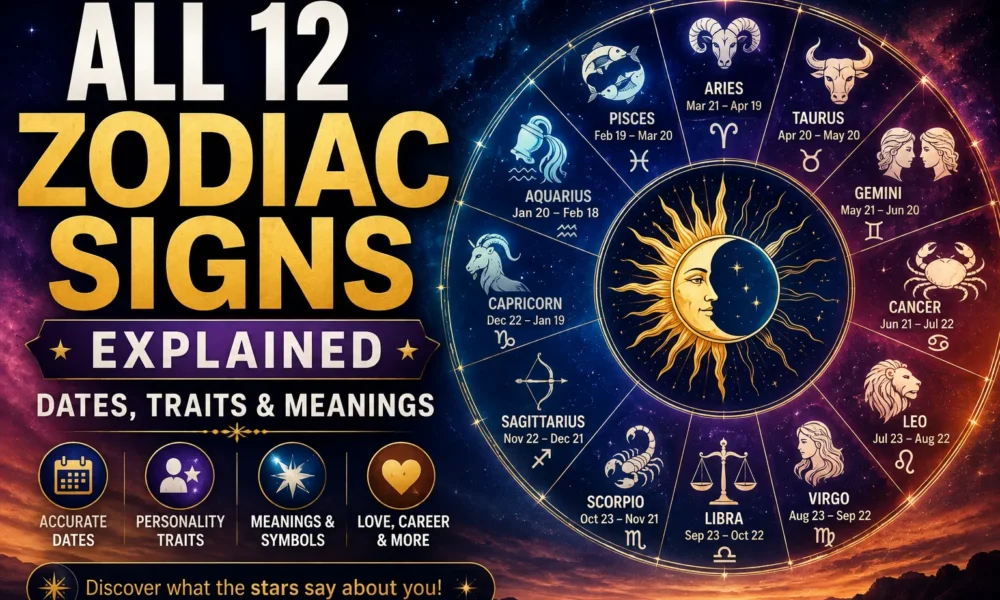
In Western tropical astrology, the signs are traditionally associated with these approximate date ranges:
| Zodiac Sign | Approximate Dates | Element | Modality |
|---|---|---|---|
| Aries | March 21–April 19 | Fire | Cardinal |
| Taurus | April 20–May 20 | Earth | Fixed |
| Gemini | May 21–June 20 | Air | Mutable |
| Cancer | June 21–July 22 | Water | Cardinal |
| Leo | July 23–August 22 | Fire | Fixed |
| Virgo | August 23–September 22 | Earth | Mutable |
| Libra | September 23–October 22 | Air | Cardinal |
| Scorpio | October 23–November 21 | Water | Fixed |
| Sagittarius | November 22–December 21 | Fire | Mutable |
| Capricorn | December 22–January 19 | Earth | Cardinal |
| Aquarius | January 20–February 18 | Air | Fixed |
| Pisces | February 19–March 20 | Water | Mutable |
Important: These dates are commonly used reference ranges, not absolute birth-date rules. The Sun can change signs at slightly different times from year to year, so someone born close to a sign boundary may need their exact birth date, time, and location to determine their Sun sign accurately.
The 12 Zodiac Signs at a Glance
Before exploring each sign individually, here’s a quick overview:
- Aries — bold, energetic, independent
- Taurus — practical, patient, dependable
- Gemini — curious, adaptable, communicative
- Cancer — caring, intuitive, protective
- Leo — confident, expressive, warm
- Virgo — analytical, organized, thoughtful
- Libra — diplomatic, social, harmony-seeking
- Scorpio — intense, determined, private
- Sagittarius — adventurous, optimistic, freedom-loving
- Capricorn — disciplined, ambitious, responsible
- Aquarius — independent, innovative, unconventional
- Pisces — compassionate, imaginative, sensitive
These descriptions represent traditional astrological interpretations rather than scientifically established personality classifications.
1. Aries — The Ram
Dates: March 21–April 19
Element: Fire
Modality: Cardinal
Traditional ruling planet: Mars
Aries is the first sign of the zodiac and is traditionally associated with initiative, action, and independence. People with an Aries Sun are often described in astrology as energetic, direct, competitive, and willing to take the lead.
Common Aries traits
Strengths:
- Courageous
- Energetic
- Confident
- Independent
- Action-oriented
Challenges:
- Impatience
- Impulsiveness
- Competitive behavior
- Short temper
Aries represents the instinct to start, act, and move forward. Its cardinal modality emphasizes initiation, while its fire element is associated with enthusiasm and action.
2. Taurus — The Bull
Dates: April 20–May 20
Element: Earth
Modality: Fixed
Traditional ruling planet: Venus
Taurus is traditionally associated with stability, patience, comfort, and practicality. As a fixed earth sign, it is often described as persistent and grounded.
Common Taurus traits
Strengths:
- Reliable
- Patient
- Practical
- Loyal
- Persistent
Challenges:
- Stubbornness
- Resistance to change
- Possessiveness
- Excessive attachment to comfort
Taurus is often connected with enjoying tangible experiences, security, beauty, and consistency.
3. Gemini — The Twins
Dates: May 21–June 20
Element: Air
Modality: Mutable
Traditional ruling planet: Mercury
Gemini is associated with communication, curiosity, learning, and adaptability. Its mutable quality is traditionally linked with flexibility, while its air element emphasizes ideas and communication.
Common Gemini traits
Strengths:
- Curious
- Adaptable
- Communicative
- Quick-thinking
- Sociable
Challenges:
- Restlessness
- Indecision
- Inconsistency
- Easily distracted
Gemini is often described as a sign that enjoys conversation, information, variety, and exploring different perspectives.
4. Cancer — The Crab
Dates: June 21–July 22
Element: Water
Modality: Cardinal
Traditional ruling planet: Moon
Cancer is traditionally associated with emotions, home, family, protection, and intuition. Astrology often portrays Cancer as caring and emotionally perceptive.
Common Cancer traits
Strengths:
- Caring
- Protective
- Intuitive
- Loyal
- Emotionally aware
Challenges:
- Moodiness
- Sensitivity
- Overprotectiveness
- Difficulty letting go
Cancer’s symbolism often centers on emotional security and creating a strong sense of belonging.
5. Leo — The Lion
Dates: July 23–August 22
Element: Fire
Modality: Fixed
Traditional ruling planet: Sun
Leo is traditionally associated with confidence, creativity, self-expression, and warmth. It is often described as a sign that enjoys recognition while also bringing enthusiasm and generosity to relationships.
Common Leo traits
Strengths:
- Confident
- Creative
- Generous
- Warm-hearted
- Charismatic
Challenges:
- Pride
- Need for attention
- Stubbornness
- Sensitivity to criticism
Leo represents creative self-expression and the desire to shine authentically.
6. Virgo — The Maiden
Dates: August 23–September 22
Element: Earth
Modality: Mutable
Traditional ruling planet: Mercury
Virgo is traditionally connected with analysis, organization, practicality, service, and attention to detail. Its earth element gives it a grounded quality, while its mutable modality supports adaptability.
Common Virgo traits
Strengths:
- Analytical
- Organized
- Practical
- Detail-oriented
- Helpful
Challenges:
- Overthinking
- Perfectionism
- Excessive criticism
- Worry
Virgo is often associated with improving systems, solving problems, and paying attention to details that others may overlook.
7. Libra — The Scales
Dates: September 23–October 22
Element: Air
Modality: Cardinal
Traditional ruling planet: Venus
Libra is traditionally associated with balance, relationships, diplomacy, beauty, and cooperation. The Scales symbolize its connection with harmony and fairness.
Common Libra traits
Strengths:
- Diplomatic
- Social
- Cooperative
- Charming
- Fair-minded
Challenges:
- Indecision
- Avoiding confrontation
- People-pleasing
- Difficulty making choices
Libra’s symbolism focuses strongly on partnership and finding balance between different viewpoints.
8. Scorpio — The Scorpion
Dates: October 23–November 21
Element: Water
Modality: Fixed
Traditional ruling planets: Mars and Pluto
Scorpio is traditionally associated with intensity, transformation, determination, privacy, and emotional depth. It is often portrayed as a sign that prefers meaningful connections over superficial interactions.
Common Scorpio traits
Strengths:
- Determined
- Loyal
- Intense
- Perceptive
- Resilient
Challenges:
- Jealousy
- Suspicion
- Possessiveness
- Difficulty trusting
Scorpio’s traditional symbolism is closely connected with transformation, emotional depth, and personal resilience.
9. Sagittarius — The Archer
Dates: November 22–December 21
Element: Fire
Modality: Mutable
Traditional ruling planet: Jupiter
Sagittarius is associated with exploration, optimism, learning, philosophy, and freedom. It is traditionally portrayed as a sign that wants to expand its understanding of the world.
Common Sagittarius traits
Strengths:
- Optimistic
- Adventurous
- Honest
- Curious
- Independent
Challenges:
- Impatience
- Restlessness
- Bluntness
- Difficulty with restrictions
Sagittarius often represents the search for knowledge, experience, meaning, and new horizons.
10. Capricorn — The Goat
Dates: December 22–January 19
Element: Earth
Modality: Cardinal
Traditional ruling planet: Saturn
Capricorn is traditionally associated with discipline, responsibility, ambition, structure, and long-term goals. It is often described as practical and willing to work steadily toward an objective.
Common Capricorn traits
Strengths:
- Disciplined
- Responsible
- Ambitious
- Patient
- Practical
Challenges:
- Rigidity
- Pessimism
- Workaholic tendencies
- Being overly serious
Capricorn symbolizes long-term effort, responsibility, and building something that can last.
11. Aquarius — The Water Bearer
Dates: January 20–February 18
Element: Air
Modality: Fixed
Traditional ruling planets: Saturn and Uranus
Despite its name and water-bearer symbol, Aquarius is an air sign in Western astrology. It is traditionally associated with independence, innovation, ideas, communities, and unconventional thinking.
Common Aquarius traits
Strengths:
- Independent
- Innovative
- Open-minded
- Intellectual
- Original
Challenges:
- Emotional detachment
- Stubbornness
- Unpredictability
- Rebelliousness
Aquarius is often connected with new ideas and challenging established ways of thinking.
12. Pisces — The Fish
Dates: February 19–March 20
Element: Water
Modality: Mutable
Traditional ruling planets: Jupiter and Neptune
Pisces is traditionally associated with imagination, compassion, intuition, creativity, and emotional sensitivity. Its water element emphasizes feelings and its mutable quality suggests adaptability.
Common Pisces traits
Strengths:
- Compassionate
- Imaginative
- Intuitive
- Creative
- Empathetic
Challenges:
- Over-sensitivity
- Escapism
- Indecision
- Difficulty setting boundaries
Pisces is often viewed as the zodiac’s deeply imaginative and emotionally receptive sign.
What Are the Four Zodiac Elements?
The 12 zodiac signs are divided into four elements: fire, earth, air, and water. Each element contains three signs.
Fire Signs
Aries, Leo, Sagittarius
Fire signs are traditionally associated with energy, enthusiasm, confidence, and action.
Earth Signs
Taurus, Virgo, Capricorn
Earth signs are linked with practicality, stability, structure, and tangible results.
Air Signs
Gemini, Libra, Aquarius
Air signs are traditionally associated with communication, ideas, social interaction, and intellectual exploration.
Water Signs
Cancer, Scorpio, Pisces
Water signs are connected with emotions, intuition, sensitivity, and depth.
What Are Cardinal, Fixed, and Mutable Signs?
Astrology also divides the zodiac into three modalities, sometimes called qualities.
- Cardinal: Aries, Cancer, Libra, Capricorn — associated with starting and initiating.
- Fixed: Taurus, Leo, Scorpio, Aquarius — associated with persistence and maintaining.
- Mutable: Gemini, Virgo, Sagittarius, Pisces — associated with adaptability and change.
Looking at both element and modality can provide more context than looking at the Sun sign alone.
Sun Sign vs. Moon Sign vs. Rising Sign
When people say, “I’m a Leo” or “I’m a Pisces,” they usually mean their Sun sign.
However, a complete astrological birth chart contains many placements.
Sun Sign
The Sun sign is based on the Sun’s position at birth and is commonly associated with identity, self-expression, and overall character in astrology.
Moon Sign
The Moon sign is traditionally associated with emotions, instincts, inner responses, and personal needs.
Rising Sign
The rising sign, or Ascendant, is the zodiac sign that was rising on the eastern horizon at the time and location of birth. Because the Ascendant changes relatively quickly, an accurate birth time is particularly important for calculating it.
This is why two people with the same Sun sign can have very different astrological profiles.
How to Find Your Zodiac Sign
For a basic Sun sign, your birth date is usually enough to identify the likely sign using the traditional date ranges.
If your birthday falls close to the beginning or end of a sign’s date range, use your exact birth date, birth time, and birthplace with a reputable birth-chart calculator. This can determine the Sun’s actual zodiac position for that particular moment.
For a more complete interpretation, calculate the full natal chart rather than relying only on your Sun sign.
Are Zodiac Sign Traits Scientifically Proven?
Zodiac personality descriptions are part of astrological tradition, not established scientific personality testing. Astrology can be useful to people as a cultural practice, reflective tool, or form of entertainment, but zodiac signs should not be treated as scientifically validated explanations of personality or behavior.
For practical decisions involving health, finances, relationships, education, or careers, astrology should not replace evidence-based information or professional advice.
Frequently Asked Questions
What are the 12 zodiac signs?
The 12 zodiac signs are Aries, Taurus, Gemini, Cancer, Leo, Virgo, Libra, Scorpio, Sagittarius, Capricorn, Aquarius, and Pisces. In Western astrology, each sign occupies a specific section of the zodiac and is traditionally associated with particular traits, elements, and modalities.
Which zodiac sign comes first?
Aries is the first zodiac sign in the traditional Western zodiac. It is associated with the beginning of the astrological year and is traditionally classified as a cardinal fire sign.
What are the four elements of the zodiac?
The four zodiac elements are fire, earth, air, and water. Fire includes Aries, Leo, and Sagittarius; earth includes Taurus, Virgo, and Capricorn; air includes Gemini, Libra, and Aquarius; and water includes Cancer, Scorpio, and Pisces.
What is the most important zodiac sign?
There is no universally “most important” zodiac sign. In a basic horoscope, the Sun sign is commonly emphasized, but a complete birth chart contains multiple planetary placements that astrologers interpret together.
Can two people with the same zodiac sign have different personalities?
Yes. Even within astrology, two people with the same Sun sign can have different birth charts because their Moon, rising sign, planets, houses, and other placements may differ. Personality is also influenced by many real-world factors that cannot be reduced to a zodiac sign.
What is the difference between a Sun sign and a rising sign?
A Sun sign is based on the Sun’s zodiac position at birth, while the rising sign, or Ascendant, is the sign rising on the eastern horizon at the birth location and time. The rising sign therefore requires an accurate birth time and place for calculation.
Final Takeaways
The 12 zodiac signs provide the basic framework of Western astrology, with each sign traditionally connected to particular traits, elements, modalities, and planetary rulers.
The simplest way to remember them is:
- Aries: Action
- Taurus: Stability
- Gemini: Communication
- Cancer: Emotion
- Leo: Expression
- Virgo: Analysis
- Libra: Balance
- Scorpio: Transformation
- Sagittarius: Exploration
- Capricorn: Discipline
- Aquarius: Innovation
- Pisces: Imagination
If you’re just starting with astrology, begin with your Sun sign, then explore your Moon sign and Ascendant to build a broader understanding of your birth chart. Most importantly, treat zodiac interpretations as traditional astrological perspectives rather than fixed definitions of who someone is.

No Comment! Be the first one.